
By the Industry News Team
The S&P/ASX 200 Health Care Index (XHJ) enters the final trading days of July carrying something it has not had for the better part of a year: momentum. After spending FY26 as the worst performer of the eleven ASX 200 sectors, health care has staged the market's sharpest reversal, and the debate among Australian institutional desks has shifted from whether the sector is cheap to whether the rebound has already run ahead of the fundamentals.
From Nine-Year Low to Sector Leader
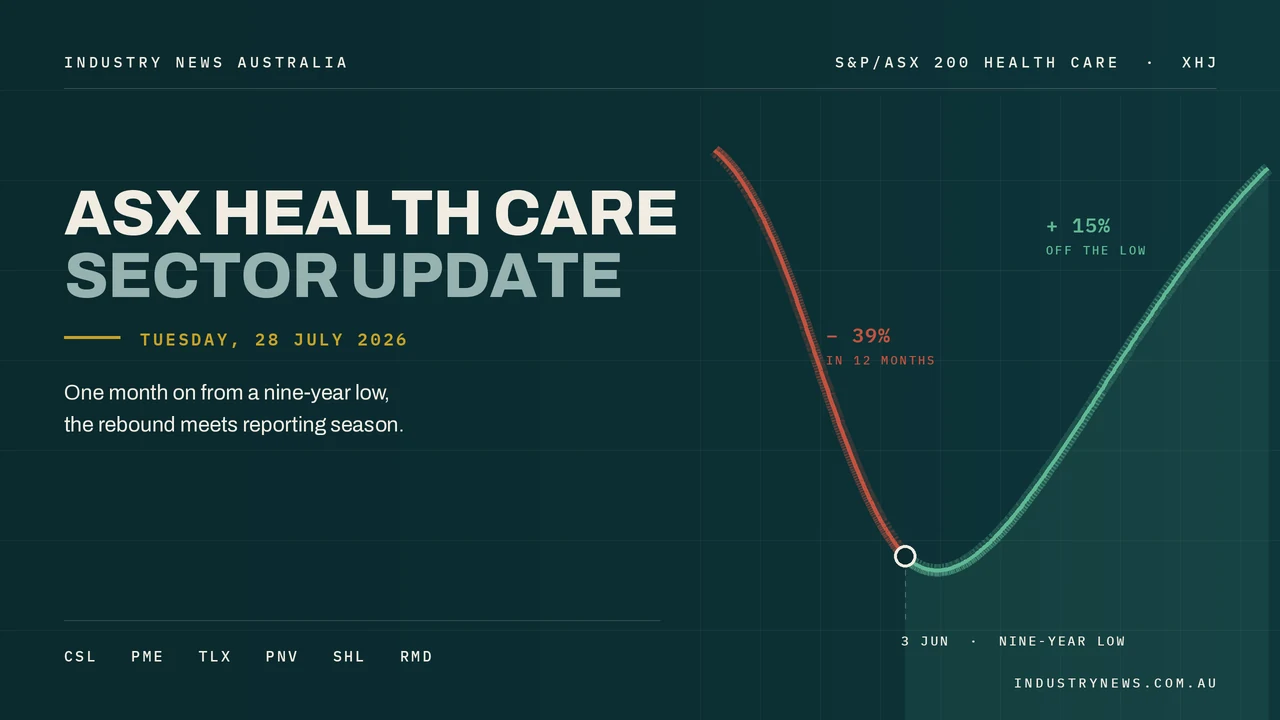
The turning point was early June, when the index touched a nine-year low after shedding roughly 39 per cent over the preceding twelve months. Since that trough the sector has recovered strongly, posting a double-digit gain through June to finish as the best of the eleven ASX sectors for the month, and repeatedly topping the weekly sector tables through July.
The character of the buying matters. This has not been a broad-based re-rating driven by earnings upgrades. It has been value-led rotation into beaten-down large caps, with fund managers taking advantage of valuations that had compressed to levels not seen since the middle of the last decade. That distinction is important, because a rotation trade and a recovery cycle behave very differently once the first round of results lands.
The Macro Backdrop Remains Restrictive
The Reserve Bank has left the cash rate at 4.35 per cent following three increases earlier in the year, with the Board signalling that financial conditions are now materially tighter and that the economy is slowing broadly as anticipated. Investors reading our earlier coverage in RBA Watch: Why a March Rate Hike is Now the Market's Base Case will recognise the trajectory that brought us here.
Two dates now sit directly in front of the sector. June quarter inflation data is released on Wednesday, 29 July, and the Monetary Policy Board next meets on 10 and 11 August. A softer print would strengthen the case that the tightening cycle is complete and support the longer-duration end of the health care market, where medical technology and imaging valuations are most sensitive to the discount rate. A hotter print does the opposite.
Currency remains the quieter variable. A firmer Australian dollar has been a persistent headwind for the sector's offshore earners, and several of the largest constituents book the majority of their revenue in United States dollars. Input costs are also still working through the system, and readers tracking operating leverage across manufacturing-heavy industries can follow the broader picture in our Energy Outlook Category, where utility and logistics costs continue to shape margin expectations for laboratory networks and device manufacturers.
A Sector With Two Personalities
The defensive label attached to health care obscures how differently its components now trade. At one end sit pathology, hospital, aged care and retirement operators, where the drivers are demographic and policy-linked: funding settings, occupancy, labour availability and volume recovery. At the other end sit imaging software, radiopharmaceuticals and medical technology, where the investment case is closer to scalable technology growth and where sentiment moves with expectations rather than with quarterly volumes.
The practical consequence is that a catalyst for one half of the sector is frequently irrelevant to the other. Investors who treated XHJ as a single defensive block during FY26 were caught out precisely because the growth-facing names de-rated with the technology complex while the structural names lagged for entirely separate reasons.
Major ASX Movers
- CSL Limited (ASX: CSL): The index heavyweight has recovered roughly a third from its early-June low, restoring billions in market value, but the stock remains down sharply for the calendar year and well below its 52-week high. Last week was a reminder that the recovery is not linear, with shares giving back ground before steadying on Monday. Broker views are openly split, with consensus targets implying further upside but a growing number of desks arguing the easy part of the re-rating is behind us. The market now wants revenue proof, not multiple expansion.
- Pro Medicus (ASX: PME): The medical imaging software provider has been the sector's clearest example of valuation sensitivity, de-rating heavily through 2026 despite a contract pipeline that remains intact. Shares steadied on Monday after a difficult stretch. Long-term holders point to North American contract wins and margin quality; sceptics point to a multiple that still prices in years of flawless execution.
- Telix Pharmaceuticals (ASX: TLX): Among the more active names this month following a pipeline and partnership update, with management guiding to FY26 revenue in the region of US$950 million to US$970 million. Regulatory milestones in its diagnostic imaging portfolio remain the primary swing factor for the share price through the second half.
- PolyNovo (ASX: PNV): Reported record group revenue for FY26 alongside improved cash generation and strong commercial sales growth, with a constructive outlook attached. The share price response has been muted, a divergence worth watching as a proxy for how much good news the small and mid-cap end of the sector is currently being credited for.
Looking Ahead
August is where this rebound is tested. FY26 results season brings the large-cap constituents back to the market with actual numbers, and the questions are specific: currency translation, plasma collection economics, cost recovery in pathology, and whether guidance can support the multiples the market has just paid to re-enter these names.
The pattern echoes the capital discipline theme running through other ASX sectors this year, including the restructuring work covered in our STO Santos Company Analysis and the rotation dynamics discussed in our ASX Financials Weekly Update. For health care, the structural demand story was never in question during the FY26 sell-off. Execution was. The next four weeks will determine whether the market's renewed enthusiasm is a genuine recovery cycle or a sharp bounce off deeply oversold levels.
Industry News Australia will continue tracking the sector through reporting season. Previous coverage is available in our Health Care category, including our June 10 sector update.
